

Should You Exercise When Your Joints Hurt?
Alexandra Russell
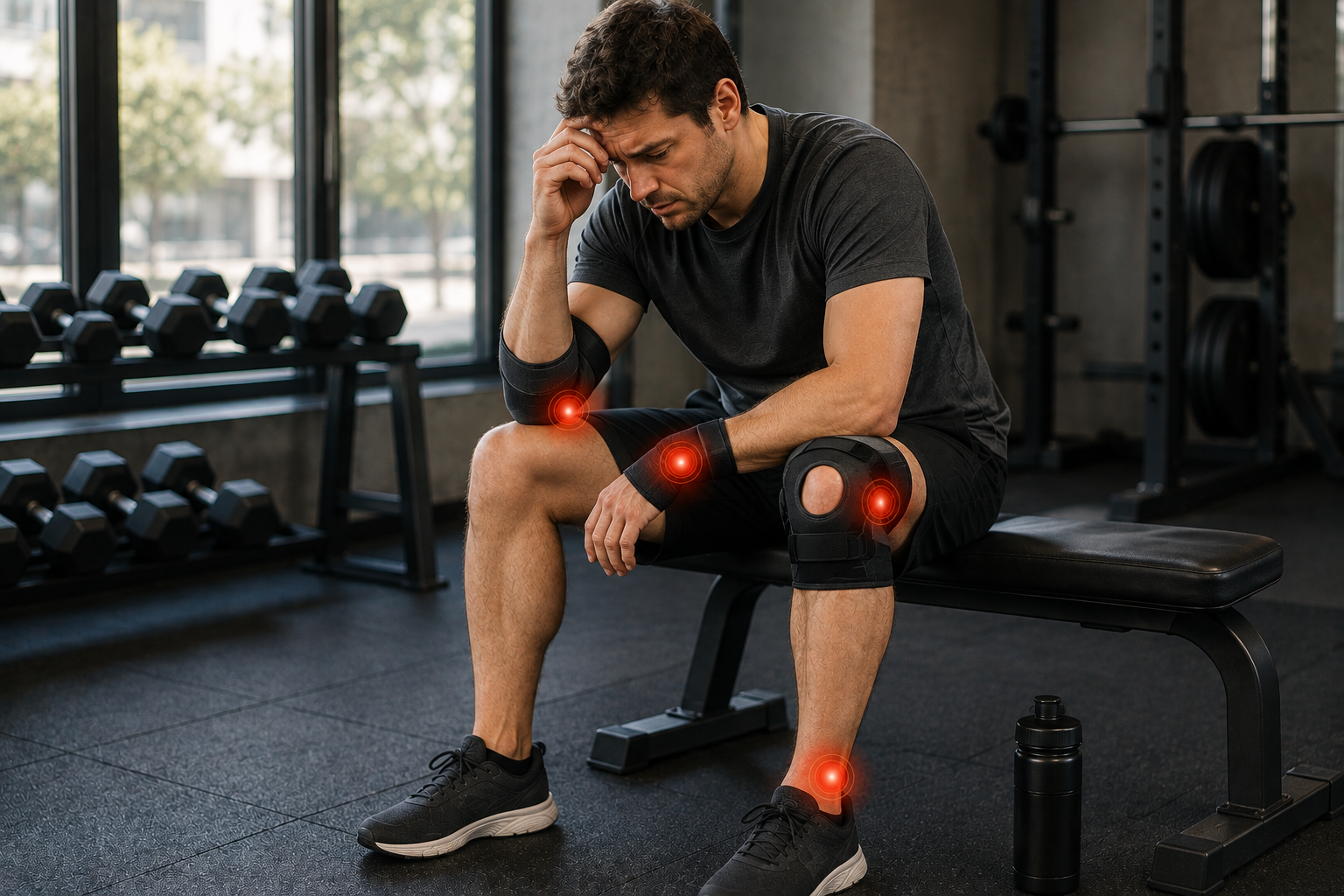
When your joints feel stiff or uncomfortable, your first instinct may be to move less.
It makes sense. If movement hurts, resting the joint can feel like the safest option.
But for many forms of ongoing joint discomfort, especially osteoarthritis, research tells a different story:
Appropriately dosed exercise can improve how joints feel and function.
That doesn't mean exercising through every kind of pain. It means that avoiding movement altogether isn't necessarily protecting your joints.
Your Joints Are Designed to Move
A joint isn't just two bones meeting together.
Muscles, tendons, ligaments, cartilage, and other connective tissues work together to create movement and stability.
The muscles surrounding a joint are particularly important because they help control movement and manage the forces placed through that joint.
When strength declines, everyday activities can become harder.
That's one reason exercise particularly strengthening exercise is such an important part of joint function.
Strength Training Can Help
Resistance exercise has strong human evidence behind it.
A 2024 systematic review found that resistance exercise lasting three to six months improved pain and physical function in people with knee or hip osteoarthritis. The authors also found that improvements didn't require rigid adherence to one exact exercise dose.
Another 2024 systematic review found resistance training improved pain, strength, and function in people with knee and hip osteoarthritis.
Why does strength matter?
Stronger muscles can provide better support and control around a joint, making everyday movements like standing, walking, climbing stairs, or lifting feel easier.
The goal isn't to make the joint avoid load.
It's to help your body handle load better.
Does Cardio Count?
Absolutely.
Walking, cycling, swimming, and other aerobic activities can also play a role in maintaining joint function.
A review comparing aerobic and strength training in people with knee osteoarthritis found clinical benefits from both approaches, without clear evidence that one was universally superior.
A broader systematic review similarly found exercise programs—including strengthening, aerobic, Pilates, and aquatic exercise—to be safe and beneficial for outcomes such as pain and strength in knee osteoarthritis.
You don't necessarily need the “perfect” joint workout.
You need movement that you can perform consistently and appropriately.
Does Exercise Wear Out Your Joints?
This is one of the most persistent joint-health myths.
It's easy to imagine your joints like mechanical parts:
Use them more → wear them out faster.
Human biology isn't that simple.
Exercise places mechanical load on joints, but normal loading is part of how musculoskeletal tissues function.
In osteoarthritis specifically, high-quality evidence supports exercise for improving pain and function rather than routine avoidance of activity. A recent Cochrane review concluded that exercise probably provides short-term improvements in pain, physical function, and quality of life in knee osteoarthritis.
That doesn't mean every exercise or every load is appropriate for every joint.
It means movement itself isn't the enemy.
What About Joint Pain After Exercise?
This is where context matters.
Muscles can feel sore after unfamiliar exercise. Joints may also temporarily feel different when training volume or intensity changes.
But persistent, severe, worsening, or unexplained joint pain isn't something to simply push through.
Exercise should be scaled to your current ability.
That may mean:
Reducing resistance
Shortening the workout
Changing the movement
Choosing a lower-impact activity
Allowing appropriate recovery
Progressive training works because the body is given a challenge it can adapt to not because pain is ignored.
You Don't Need to Train Like an Athlete
Joint-supportive exercise can be surprisingly simple.
Walking.
Body-weight movements.
Resistance bands.
Weight training.
Cycling.
Swimming.
The literature does not tell us that everyone needs one specific exercise method.
What consistently matters is regular movement and maintaining the strength needed for daily function.
So if your joints feel stiff, the solution isn't necessarily a brutal workout.
Sometimes the goal is simply to keep moving.
Recovery Still Matters
Exercise provides the stimulus.
Recovery gives your body time to adapt.
That means adequate sleep, nutrition, appropriate training volume, and rest still matter.
And when we're talking about joint recovery, we shouldn't automatically treat all inflammation as something that needs to be eliminated.
Inflammatory signaling is part of normal tissue response and adaptation.
The goal is not:
“Stop all inflammation.”
It's maintaining comfort, mobility, strength, and function while giving your body appropriate time to recover.
Where Joint Support Supplements Fit
Supplements shouldn't replace movement.
If strengthening the muscles around a joint can improve function, no capsule can reproduce that training effect.
But certain ingredients have been studied as adjuncts for joint comfort and function.
That's how joint supplementation should be viewed:
Support for the foundation not a replacement for it.
Exercise, appropriate recovery, and healthy lifestyle habits remain the starting point.
The Bottom Line
When your joints feel uncomfortable, doing nothing can feel like the safest choice.
But the research particularly in people with knee and hip osteoarthritis consistently shows that appropriately prescribed exercise can improve pain, strength, and physical function.
You don't need to punish your joints.
You need to help your body become better equipped to support them.
Move regularly. Build strength gradually. Recover appropriately.
Healthy joints aren't necessarily joints that never experience load.
They're joints supported by a body that's prepared to move.


Share and get 15% off!
Simply share this product on one of the following social networks and you will unlock 15% off!