

Coffee vs. Energy Drinks: What Actually Makes a Better Energy Boost?
Alexandra Russell
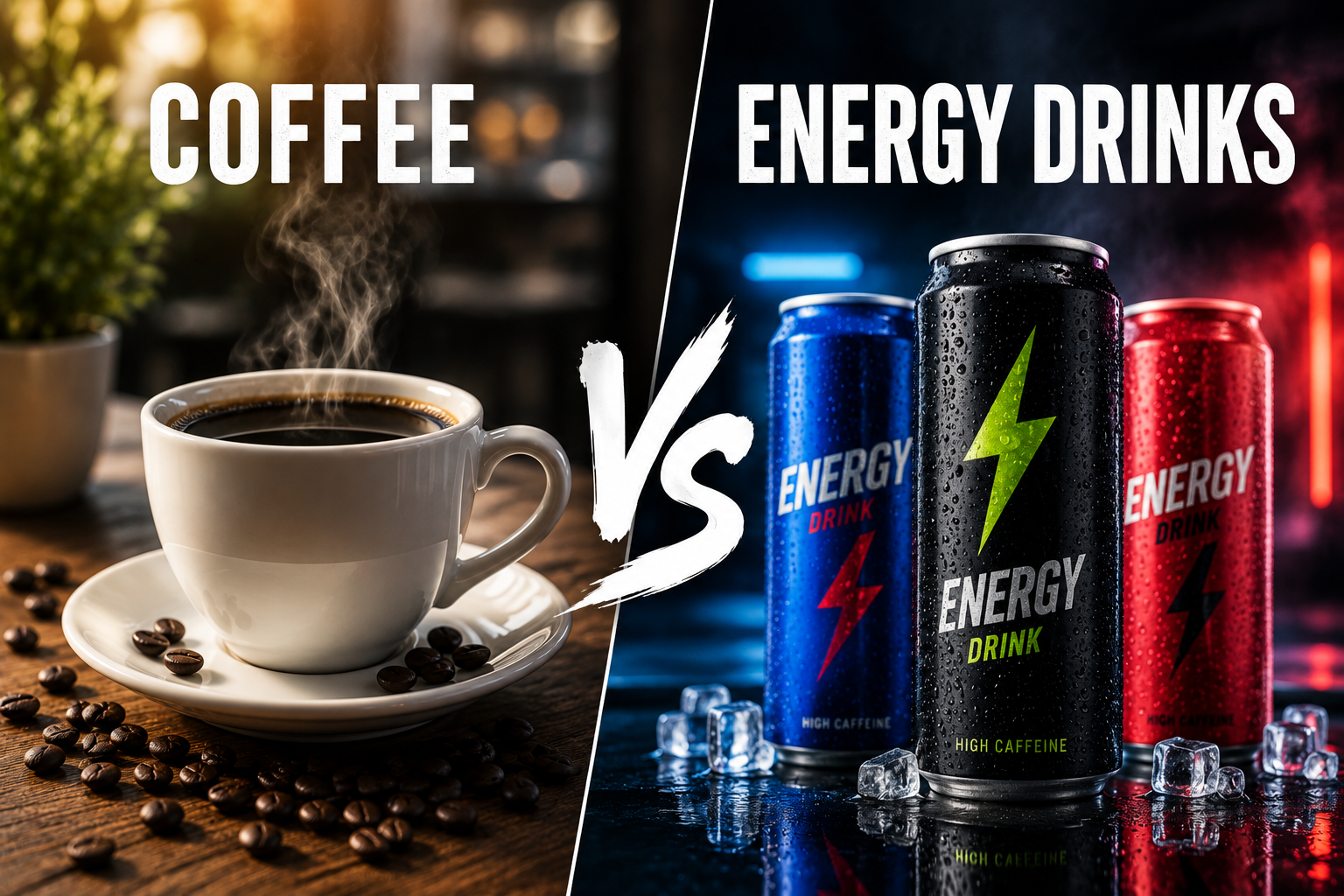
Coffee. Matcha. Energy drinks. Energy powders.
Walk into almost any office in the afternoon and you'll probably find some combination of all four.
They may look completely different, but many of them share the same ingredient responsible for most of the immediate increase in alertness:
Caffeine.
So is coffee actually better than an energy drink?
Or can a formulated energy product offer something coffee doesn't?
The answer isn't as simple as the marketing on either side makes it sound.
Start With What Actually Makes You Feel Awake
Caffeine is a stimulant that primarily works by antagonizing adenosine receptors in the brain.
As adenosine signaling is reduced, feelings of sleep pressure are temporarily suppressed and alertness can increase.
Whether that caffeine came from coffee, tea, or another source doesn't fundamentally change what the caffeine molecule is.
In fact, randomized research comparing coffee with an energy drink containing equivalent amounts of caffeine found similar caffeine pharmacokinetics.
So:
“Natural caffeine” isn't automatically a different kind of caffeine.
That's an important distinction.
What can be different is how much caffeine you're consuming and what comes with it.
Coffee: Simple and Effective
Coffee doesn't need to be demonized.
It's one of the most widely consumed sources of caffeine in the world, and caffeine has substantial evidence supporting increased alertness and aspects of cognitive and physical performance.
For someone who enjoys coffee and simply wants caffeine, coffee may be perfectly reasonable.
But there's one practical issue:
Caffeine content can vary.
Cup size, bean type, preparation method, and serving can all influence how much caffeine you're actually consuming.
And the giant coffee you pick up on the way to work isn't necessarily equivalent to the “one cup” you picture when thinking about caffeine intake.
Energy Drinks: Read Past the Front of the Can
Energy drinks are harder to discuss as one category because their formulas vary dramatically.
One might contain caffeine and sugar.
Another might contain caffeine, taurine, B vitamins, amino acids, electrolytes, botanical extracts, or a combination of several ingredients.
That means asking:
“Are energy drinks better or worse than coffee?”
isn't particularly useful.
A better question is:
What's actually in this energy drink and at what dose?
That's where the ingredient label becomes much more important than the word “energy.”
Caffeine + L-Theanine: An Interesting Combination
L-theanine is an amino acid naturally occurring in tea.
Unlike caffeine, it isn't a conventional stimulant.
Researchers have become particularly interested in what happens when L-theanine and caffeine are consumed together.
A 2025 systematic review and meta-analysis of randomized controlled trials found that the combination may produce small-to-moderate benefits in certain measures of attention and cognitive performance, although effects weren't significant or consistent across every outcome.
That's enough evidence to make the combination interesting.
It is not enough to promise:
“Zero jitters.”
“No crash.”
“Perfect focus.”
Those are marketing claims not conclusions we can confidently draw from the research.
What Does Taurine Actually Do?
Taurine shows up in many energy drinks, which has led people to assume it's another stimulant.
It isn't.
Taurine is an amino-sulfonic acid naturally present in the body and involved in several physiological processes.
Research has investigated taurine in relation to exercise performance and cognition, but the evidence that taurine and caffeine together create a unique synergistic “energy” effect remains inconclusive.
So taurine shouldn't simply be translated into:
“More energy.”
That's not what the science establishes.
B Vitamins Don't Work Like Caffeine
This is another common misunderstanding.
B vitamins appear on countless energy-product labels.
And there's a legitimate biological reason for that.
Several B vitamins participate in metabolic pathways involved in converting nutrients from food into forms of energy your cells can use.
But here's the important distinction:
Being involved in energy metabolism isn't the same thing as stimulating you.
A B vitamin doesn't behave like caffeine.
And if you're already getting adequate amounts, taking increasingly larger quantities doesn't mean you'll feel increasingly energetic.
They're essential nutrients.
Not stimulants.
What About Electrolytes?
Electrolytes including sodium, potassium, magnesium, and calcium have important physiological roles involving fluid balance, nerve signaling, and muscle function.
They're particularly relevant when you're losing significant fluid and electrolytes through sweating, prolonged exercise, or heat exposure.
Research supports electrolyte-containing beverages as useful tools in rehydration following exercise-associated fluid loss.
But electrolytes don't automatically create energy.
If you're sitting comfortably at a desk and eating a normal diet, you don't necessarily need an electrolyte drink simply because it's 2 p.m.
Again:
Context matters.
And Then There's Sugar
Traditional energy drinks can contain substantial amounts of added sugar.
Others contain little or none.
Coffee can be nearly calorie-free or turn into a high-sugar beverage depending on what you add to it.
So comparing “coffee versus energy drinks” based on sugar doesn't work unless you're comparing specific products.
Read the label.
A category doesn't tell you what's actually in the drink.
So Which Is Better?
There's no universal winner.
Coffee can be a straightforward way to consume caffeine.
Tea can naturally provide caffeine alongside compounds such as L-theanine.
Energy drinks and powders can combine caffeine with additional ingredients but those ingredients only matter if they have a meaningful physiological role and are present in an appropriate amount.
That's the point most marketing skips.
A longer ingredient list isn't automatically better.
Neither is a shorter one.
What matters is whether each ingredient has a reason to be there.
Why EnduraFuel Was Formulated Differently
EnduraFuel was designed around that idea.
It combines caffeine with L-theanine, taurine, B vitamins, and electrolytes rather than treating “energy” as synonymous with simply increasing the stimulant dose.
Each component serves a different purpose.
Caffeine supports alertness.
Caffeine + L-theanine has research supporting certain aspects of attention and cognitive performance.
B vitamins participate in normal energy metabolism.
Electrolytes support normal fluid balance and physiological function, particularly when fluid losses increase.
Taurine has physiological roles of its own, although we don't pretend the research proves it magically amplifies caffeine.
That's what a science-based formula should look like:
Not making every ingredient sound miraculous. Understanding why it's actually there.
The Bottom Line
Coffee isn't bad.
Energy drinks aren't automatically bad.
And a product isn't better simply because the label says “natural energy.”
Look past the category.
Look at the caffeine dose, additional ingredients, sugar content, timing, and what you're actually trying to accomplish.
If all you want is a cup of coffee, drink your coffee.
If you want a formulated product containing caffeine alongside other functional ingredients, understand what each ingredient actually contributes.
Because when coffee isn't cutting it, the answer isn't necessarily finding the drink with the most caffeine.
It's understanding what you're putting into your body—and choosing it for a reason.


Share and get 15% off!
Simply share this product on one of the following social networks and you will unlock 15% off!